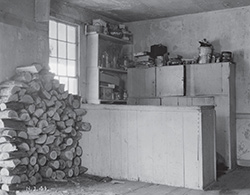
1938 photograph
of Cedar Bridge Tavern bar
Photo Credit: American Building Survey
Cedar Bridge Tavern Historic Site sits on 327 acres. The site includes a fully restored historic tavern with exhibits, 3.5 mile trail, outdoor picnic tables, restrooms, and short walking paths. There is no admission charge. For detailed information on site access and accessibility, please refer to this What to Expect.pdf
The building is open Thursday-Monday 10 AM – 4 PM, year-round.
For more information or to arrange school and group tours contact (732) 929-4769 or culturalheritage@co.ocean.nj.us
Brief History
Cedar Bridge Tavern dates back to c. 1816, however, the history of the site reaches much further. The last land engagement of the American Revolution is purported to have occurred at the site on December 27, 1782.
Remnants of an original c. 1740 tavern have been found through archaeological research just east of the c. 1816 tavern visitors enjoy today. In an 1801 newspaper advertisement, the original tavern is described as having “one hundred and sixty-three acres of Land, small frame and log house, frame barn, stable wagon house, and large shed, on log stable, a saw-mill in good repair, a small bearing orchard, the land in good cedar fence.”
The c. 1816 Cedar Bridge Tavern surrounding acreage are a historic treasure that offers a unique window into the European experience in the New Jersey Pinelands. From about 1740, a saw mill existed on the nearby branch of the Wading River and the town grew around the intersection of a major east/west thoroughfare and a southern route to reach Egg Harbor and Tuckerton. The 18th century crossroads of the east-west Old Springfield Road from Springfield in Burlington County to Manahawkin in then Monmouth County. Later roads where built in front of the tavern to reach further into Barnegat. It is on the original stagecoach route from the west to the shore. The old road to Egg Harbor (later Little Egg Harbor – Tuckerton) is only a few hundred yards west of the tavern.
Eventually, two taverns in this hamlet served the travelers, hunters and rural region. Historic maps from about 1750 show Pettit’s or Cedar Bridge as a named place on state and wider regional maps. A rich collection of traveler and academic references speak to the importance of this long overlooked community.
The property’s previous owner, Rudolph Koenig, a somewhat reclusive and mysterious man, occupied the historic building as his residence from 1959. He originally bought about 211.6 acres for $12,000 from the Penn Producing Company and eventually sold all but five of those acres to the New Jersey Conservation Foundation. Today, Cedar Bridge Tavern is a gateway to the postindustrial forests of the NJ Pinelands.
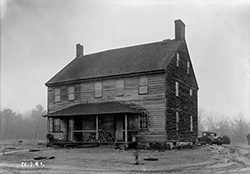
Cedar Bridge Tavern 1938
Photo Credit: American Building Survey
Historic Preservation
The historic tavern restoration is the result of extensive architectural and archeological research that has resulted in the tavern being placed on the prestigious New Jersey and National Register of Historic Places on Aug. 8, 2013. The restoration of Cedar Bridge Tavern was completed in 2018.
The multi-year renovation project to the circa 1816 building with an 1830’s kitchen addition took place under the direction of the Ocean County Board of Commissioners, the Ocean County Department of Parks and Recreation and its Cultural and Heritage Commission. The completed tavern and property now stands as a historical showpiece in the County park system. As one of the most accurate and authentic restorations in New Jersey of this type of structure, the project allows Ocean County to leave a legacy to future generations.
The Ocean County Board of Commissioners purchased Cedar Bridge Tavern on Dec. 27, 2007. As part of the sale, the Commissioners granted Rudy Koenig, the owner-resident from 1959 a “life-estate” to live in the building for the remainder of his life. Mr. Koenig passed on Jan. 12, 2012 and the County began the work of removing the non-historic elements from the home. Meanwhile funded in part by grants totaling $324,926 through the New Jersey Historic Trust, the County hired consultants and contractors to renovate the tavern.
As part of the project’s preliminary work, Annabelle Radcliffe-Trenner, principal of Historic Buildings Architects, LLC, Trenton, conducted a comprehensive preservation plan for the site, designed the plans, managed the prequalification of contractors and oversaw the detailed and historically appropriate restoration work. Ocean County Parks & Recreation staff removed over ten containers of non-historic materials and has cared for the landscape in an effort to maximize protection from forest fires. The tavern grounds have been the site of two digs (2010-2014) by the Monmouth University Archeology Field School directed by Dr. Richard Veit.
Cedar Bridge Tavern sits on wooded acreage in the Pine Barrens about a mile south of Route 72. To get a glimpse of the building you must travel down a bumpy dirt road, deep into the woods. Significantly, the original section of Cedar Bridge Tavern retains an early 19th-century bar, a character-defining feature not known to survive in any extant early American New Jersey tavern. The tavern also retains most of the original interior floor plan, including bar room, dining room, and bedrooms, along with most of the original doors, trim, windows, and fireplaces. Cedar Bridge Tavern is also significant for its ability to provide information on 19th-century farmsteads, taverns, consumerism, entertainment, and foodways in the New Jersey Pinelands region.
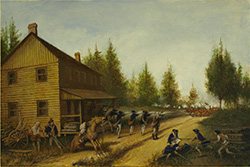
Affair at Cedar Bridge Tavern
Photo Credit: Louis S. Glanzman
The Affair at Cedar Creek Bridge
Historical research leaves some uncertainty as to which of the more than a dozen sites in what is now Ocean County named with the words “cedar,” “bridge,” and “creek” is the location of this multiple documented engagement. In any event, on December 27, 1782, after searching for the notorious loyalist Captain John Bacon, Captain Richard Shreve of Burlington County Light Horse and Captain Edward Thomas of the Mansfield militia stopped with their men to refresh themselves at a nearby tavern. Bacon and his band of Loyalists surprised the Burlington militia and blocked their escape.
As the militia gained the advantage, they were fired upon unexpectedly by a party of locals, who came to the aid of the loyalists and provided a diversion that allowed Bacon to escape. Among the Patriots, one was killed on the spot and four wounded (including one mortally wounded). Four Loyalists were also wounded, including Captain Bacon.
A ceremony commemorating the last documented land engagement of the American Revolution is held on the site each year on the first Sunday in December.
View Cedar Bridge Tavern's page on OceanCountyParks.org
|